





At the most recent AI and Theology working group meeting Dr. Yannis Papakonstantinou presented on the potential emergence of superintelligence through AI. He proposed that superintelligence is not just a technological milestone but also a profound metaphysical event with implications for our understanding of humanity, the universe, and even God.
He began with a review of the earliest efforts towards AI in the 1980s, which ran on rule-based systems, and which ultimately failed due to the impracticality of encoding the vast complexity of human common sense. This limitation was overcome with the advent of machine learning, particularly deep learning, which shifted the paradigm from explicit programming to systems that “learn” from data.The capacity for deep learning important milestone was the ability of neural networks to recognize images—such as cats and dogs—without being told what a cat or dog is.
The emergence of large language models (LLMs), such as those developed by OpenAI and Google, brought about a new form of AI capable of producing human-like responses, generating travel guides, or reasoning through questions. These systems have not been explicitly programmed with each answer; rather, they learn patterns from massive datasets. This surprising capacity brings us closer to artificial general intelligence (AGI), or AI systems that can perform any intellectual task a human can.
AGI and Superintelligence
AGI, while still loosely defined, is seen as the point at which AI matches or surpasses human ability across a wide range of cognitive tasks. But beyond AGI lies “superintelligence”—a level of intellect that surpasses the best human minds in virtually every field. The possibility of machines designing even better machines leads to an “intelligence explosion,” a term first proposed by mathematician I. J. Good in 1965. Good speculated that the first ultraintelligent machine could be the last invention humanity would need to make, as such a machine could take over the process of innovation entirely.
The Singularity and Its Implications
The singularity represents a moment beyond which human comprehension breaks down—akin to a physical singularity in a black hole where the laws of physics collapse. As Dr. Papakonstantinou pointed out, the post-singularity world would be as unintelligible to us as modern society might be to a mouse. This human grappling with the limits of human knowledge echoes themes from science fiction, like The Matrix or Blade Runner, where reality and humanity are questioned through the lens of synthetic beings and simulated environments.
Disenchantment and Re-Enchantment
Dr. Papakonstantinou then noted that this technological trajectory–and the limits of human knowing that the singularity brings to the fore–necessarily leads to theological and metaphysical questions. Traditionally, humans have believed in a divinely created universe. However, modern science, especially since the Enlightenment, has disenchanted the world by reducing it to mechanistic processes. Yet the emergence of AI and superintelligence might reintroduce enchantment—not through mysticism, but through rational progress.
This technological “re-enchantment,” as Dr. Papakonstantinou puts it, posits that God is not a supernatural exception but a natural evolutionary endpoint. Thinkers like Ray Kurzweil envision the universe progressing from particles to molecules, to life, to brains, to civilizations, and ultimately to self-aware technological superintelligence. This may lead to a “waking up” of the universe—similar to the planet-sized mind in Solaris or the divine monolith in 2001: A Space Odyssey.
Are We Already Inside a Created Universe?
Dr. Papakonstantinou then led the group in an intriguing, if provocative, hypothesis: what if we are already living inside a created (or simulated) universe? Inspired by works like Asimov’s “The Last Question,” this line of inquiry suggests that if it’s possible to create a universe via computation, then it’s plausible this has already occurred. If so, the chances that we live in the original universe (rather than a simulated one) are statistically slim. This aligns with philosopher Nick Bostrom’s simulation argument, which asserts that if any civilization ever reaches the ability to run many simulations, it’s likely we are in one. While this may at first sound alarm bells for traditional Christians, within the Orthodox worldview–especially in the apophatic tradition–we acknowledge that all things are possible with God, and that the Holy Spirit is “everywhere present.” Whether we are living in “the original” universe, or a derivative reality, we rest assured in the omniscient, everywhere present God of the fathers.
Philosophical Echoes
The concept that the universe maynot be everything that it appears to be is of course not new. Plato’s Allegory of the Cave, Zhuangzi’s Butterfly Dream, Descartes’ Evil Genius, and the “brain in a vat” thought experiment all question the nature of reality. The Matrix recycles these ideas but adds a dark tone—suggesting our simulated reality is controlled by malevolent machines. This contrasts with historical mystical traditions, which embraced being part of a created cosmos with awe rather than dread.
A Rational Path to God
One of the most profound implications of this line of thought is theological: that the existence of God need not be a supernatural assumption but can be the inevitable result of intelligence evolving far enough. From this angle, God is not a creator from outside the system but a future emergent entity from within it. While not compatible with an Orthodox understanding of creation, this proposition nonetheless presents us with helpful interlocutors for sharpening our own Orthodox understandings of God, creation, and self. Perhaps most interestingly, the proposition of an emergent God flips the traditional critique of religious belief from thinkers like Dawkins and Hawking, who argued that God is an unnecessary assumption. If superintelligent, universe-creating entities naturally emerge from rational processes, then the idea of God becomes a logical endpoint, not a mystical detour. The next question of course would be how to dialogue with such ideas without slipping into Process Theology.
Enchantment, Ethics, and AI in Society
The presentation concluded with a reflection on how AI might bring back a sense of wonder and enchantment that modernity stripped away. This enchantment is not blind belief, but awe in the face of the rational potential of intelligence to produce meaning, beauty, and mystery.
This has implications for ethics, spirituality, and economics. As AI systems begin to perform most human work, society must shift from valuing people based on productivity to valuing them based on being. It may also prompt a rethinking of our place in the cosmos—away from a human-centric view, and toward a more integrated vision of intelligence evolving toward divinity, or what we might think of as Theosis.
Final Reflections
Dr. Papakonstantinou concluded with the famous story about St. Augustine’s insight in regard to the ineffability of the divine. Walking along the beach one day, St. Augustine encountered a child who was pouring water from the sea into a hole that he had dug. When Augustine chided the boy for trying to transfer the entire ocean to his small self-made hole in the sand, the child (who turned out to be an angel) pointed out that so too, the human mind cannot comprehend the superintelligence of God. Our best approach may be awe, not analysis.
Thus, the rise of AI is not just a technological milestone but potentially a sacred turning point—one that challenges our philosophical assumptions and invites us to reconsider the possibility of God, meaning, and purpose in the universe.
Recent Articles
-
Archbishop Elpidophoros Latest News The Archdiocese
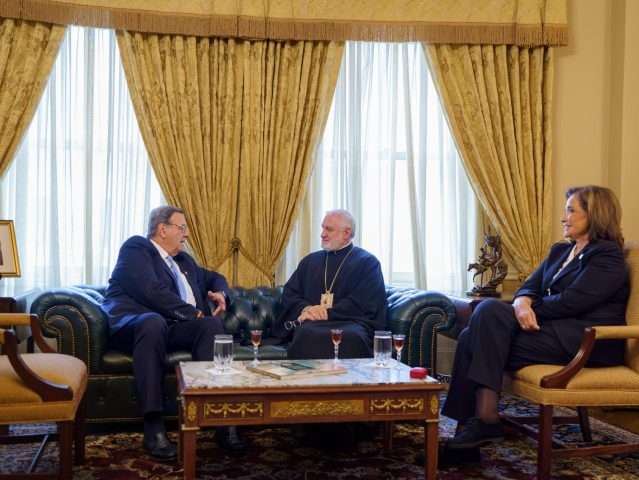
 Hellenic Olympic Committee President Isidoros Kouvelos, left, and former Greek Foreign Minister Dora Bakoyannis, right, meet with His Eminence Archbishop Elpidophoros of America at the Greek Orthodox Archdiocese of America headquarters in New York on Oct. 14, 2026. Photo by Orthodox Observer/Yannis Malevitis5 min read