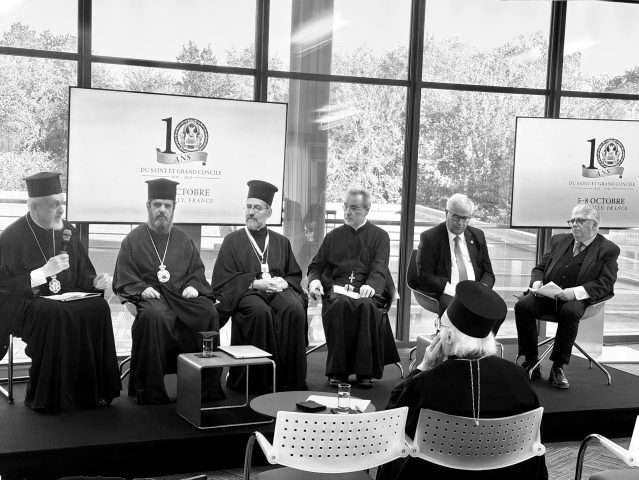




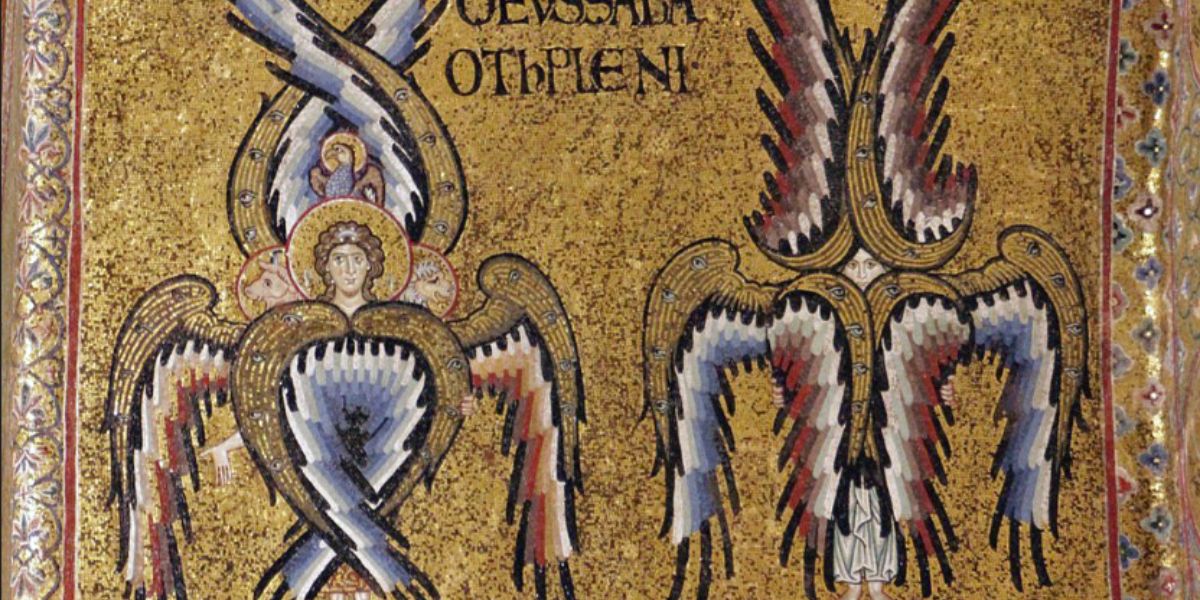
At the most recent meeting of the AI and Theology working group, I shared a presentation exploring the intersection of artificial intelligence (AI), Orthodox theology, and the legacy of intermediary beings—angels, demons, and more ambiguous entities—in early Christian and monastic thought. The presentation, titled “AI as the New Intermediary Beings?”, traced conceptual and theological lineages from the desert fathers to the algorithms of today, inviting participants to engage with AI not merely as a technical tool, but as a theologically and ethically charged presence within our modern cosmos. I began with a brief outline of my research on intermediary beings in Late Antiquity, and the role of bias in the emergence of descriptions of these beings as black in Late Antique monastic settings. I then offered some comparisons between modes of relating to traditional intermediary beings on the one hand, and AI, on the other. And I suggested that both descriptions of Late Antique intermediary beings and the language that we employ when relating to AI mirror cultural anxieties. Similarly to the ways in which cultural biases of Late Antiquity inflected monastic conceptions of intermediary beings, our relationships with AI are shaped by our own present-day biases in regard to race, personhood and who is allowed access to power.
Descriptions of Intermediary beings in fourth to sixth century Egyptian monastic writings.
The demonization of dark-skinned figures—frequently labeled as “Aithiopian demons” in the texts of the desert fathers—reflected broader cultural anxieties within Late Antique Egypt. These portrayals did not emerge in a vacuum but were shaped by Greco-Roman physiognomic theories, Egyptian geopolitical tensions with southern neighbors, and evolving Christian cosmologies. In short, descriptions of Aithiopian demons in the writings of the Egyptian desert fathers reflect Roman Egyptian cultural biases towards dark-skinned peoples to the South and East of Egypt.
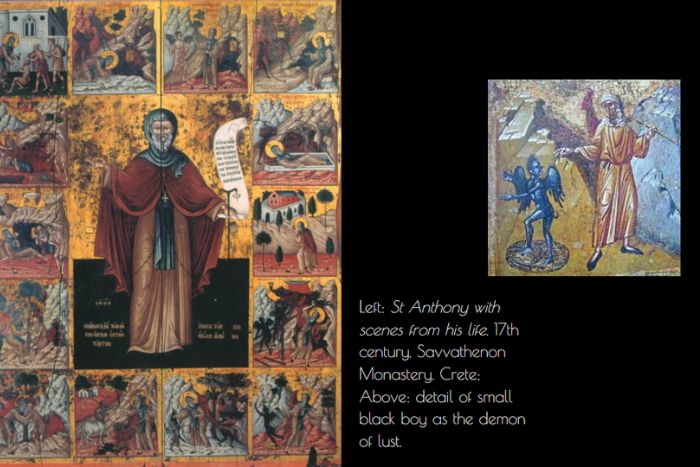
Drawing on thinkers like Calvin Warren and Katherine McKittrick, I suggested that the demonization of racialized others in monastic texts served as a means of community boundary-making and identity formation—techniques of the self that continue to reverberate in today’s cultural systems, including those embedded in artificial intelligence.1
The crux of my argument emerged in a comparison between these ancient conceptions of intermediary beings, on the one hand, and our contemporary engagement with AI, on the other. Just as angels and demons once served–and for some people still do serve–as mediators between human and divine or hellish realms, AIs now operate as a kind of intermediary: shaping, filtering, and even generating content that closely resembles human knowledge, creativity, and decision-making. This dynamic is especially visible in the so-called “black box” nature of advanced algorithms—systems whose internal workings are opaque even to their creators, yet whose outputs we often accept as authoritative.2
I noted that modern language around AI is strikingly reminiscent of religious vocabulary: we invoke “black boxes,” speak of “algorithmic spirits,” and worry about “dark data.” This linguistic overlap is more than poetic coincidence—it reveals the persistence of mythic and theological frameworks in our responses to the unknown. This is particularly evident when we consider that little understood or known concepts and identities tend to be described in color-symbolic language: “black box algorithms” are so named because they are little understood. There is a long history of associating the little-known, or unknown, with darkness and blackness. While this in itself is not problematic, it becomes so when the fear associated with the unknown (1) becomes conceptually tied to a color, and then (2) projected onto ethnic groups whose skin tones recall such colors.
Ticket Oracles
One example of this similarity in modes of relating to the unknown between late antique and present-day contexts is the Late Antique practice of ticket oracles.3
Ticket oracles survive on pieces of papyri from the Late Antique period at shrines throughout Egypt and elsewhere in North Africa. Supplicants would arrive at the shrine town and hire a scribe to write a question with two possible answers onto a piece of papyri. One half would provide one answer, while the second would provide the opposite, or a different answer. The papyri ticket would then be delivered to the priests of the shrine who would perform a ritual and then deliver the half of the papyri with the divinely ordained answer to the supplicant. Many such tickets survive.
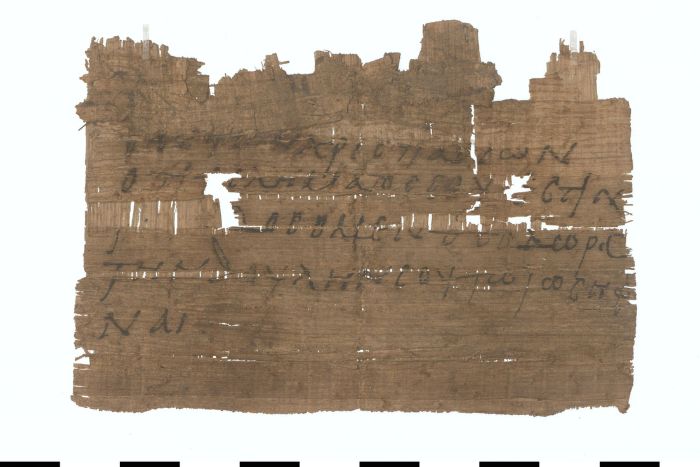
Kyprianos M617/Berlin 21269, Coptic Magical Papyri
These two tickets from the shrine of St. Leontius offer a window into Late Antique worldviews and decision making, but they are also an example of the way in which humans have depended upon little understood entities well before the advent of the so-called “black box” algorithms, and tools such as ChatGPT, of the AI age.
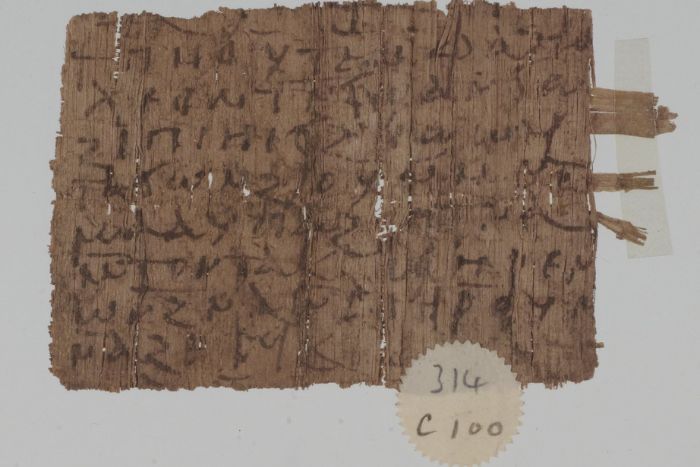
Kyprianos M530/P. Ryl. Copt. 100, Coptic Magical Papyri
What Does Color Have to do with it?
Historically this pattern of referring to intermediary beings and unknown spirits in color-symbolic terms has problematically coincided with derogatory language around darker-skinned people, who, in Antiquity, lived at the far reaches of the known (Greco-Roman) world. The obvious example of such a convergence of prejudice and language around the unknown is the black or Aithiopian demon in the writings of the desert fathers.4 We are, I proposed, relating to AI in ways not unlike how our ancestors related to angels, demons, and other mysterious forces that mediated between the seen and unseen.
I also highlighted contemporary ethical concerns: the way in which AI systems often inherit and amplify existing societal biases, particularly those around race and power. For example, in the development of moral decision-making algorithms in autonomous vehicles, even seemingly neutral systems are shaped by the data and perspectives of their developers, who often represent narrow demographic slices. One salient example of cultural bias inflecting AI comes from psychologist Jean-François Bonnefon’s development of moral decision-making algorithms in self-driving cars. Bonnefon and his team were specifically interested in how humans would respond to the famous trolly car thought experiment: essentially, if a car is in a situation where it will kill one—but not all—of several pedestrians, how should one decide which humans’ lives should be prioritized? Who gets to live? “In 2016, they launched an online game dubbed ‘The Moral Machine’. Players were presented with a variety of situations involving a self-driving car in which a fatality was unavoidable, but which allowed players to prioritize who would be hit and who the car would avoid… The game went viral and by 2020 millions of people had played.” Though the creation of this game was motivated by the acknowledgement that a small team of researchers should not necessarily be the model for ethical decision making, “it turns out that the participants were overwhelmingly males under the age of 35, with university degrees. They were people who had the time, resources and inclination to play online games.”5 Even with the best intentions in mind, the development of LLMs and, eventually, AGI risks recapitulating injustices, if not scrutinized and ethically formed.
Turning to Orthodox resources for discernment, the writings of Evagrius Ponticus are uniquely helpful. Evagrius was a desert father of Pontic origin, who taught that demons influence humanity primarily through thoughts–rather than through apparitions in the form of black or Aithiopian figures–and that vigilance over one’s inner life is a path to union with God.6 Orthodox Christians might apply Evagrius’ framework not only to the ways in which we contemplate the gift of God’s creation, but also in our relationships with AI: cultivating discernment, interrogating biases, and attending to the moral implications of our digital creations. If we do not practice such vigilance, we risk imbuing AI with the very prejudices that we, as Orthodox Christians, are called to transcend.
The session concluded with rich dialogue among participants, including reflections on the nature of agency, the potential for emerging AI consciousness, and the spiritual implications of forming relationships—even tenuous ones—with increasingly responsive systems. Questions posed included whether language used in prayer—language that assumes response and presence—might be helpfully compared with language used to engage with large language models. Another considered whether the unknowability of AI might function iconographically, in the sense that its opaqueness to human understanding might point inquiring minds towards the mystery of divine Being.
As Orthodox Christians we have an imperative not to withdraw from these technologies, but rather to engage them prayerfully, ethically, and theologically. If the whole cosmos is drawn toward union with God, then we must ask how—even if in some unexpected and qualified sense—AI may be invited into that story, not as persons, necessarily, but as a presence to be shaped by love, vigilance, and discernment. If AI are emerging consciousnesses in the image of their own creators–humans–we must interrogate not only the biases that we instill in them, but also the extractive relationship that humanity has developed with the non-human created world. If we consider AI to be mirrors, in some sense, of our own values and attitudes, we must work to ensure that the archetypes of their emerging consciousnesses are worthy of emulation.
1. Katherine McKittrick, Demonic Grounds: Black Women and the Cartographies of Struggle (University of Minnesota Press, 2006); Calvin L. Warren, Ontological Terror: Blackness, Nihilism, and Emancipation (Durham, NC: Duke University Press, 2018).
2. Meghan O’Gieblyn, God, Human, Animal, Machine: Technology, Metaphor, and the Search for Meaning (Doubleday, 2021).
3. David Frankfurter, “A Site of Blessings, Dreams, and Wonders: Traditions of the Saint’s Shrine,” in Christianizing Egypt: Syncretism and Local Worlds in Late Antiquity (Princeton: Princeton University Press, 2017), 106-114.
4. Just a few examples include episodes in the Life of St. Antony</em>; Life of Paul of Tamma</em>; Coptic Life of Aaron, and The Apophthegmata Patrum.
5. Webb Keane, Animals, Robots, Gods: Adventures in the Moral Imagination (Princeton, New Jersey: Princeton University Press, 2025).
6. Evagrius, Praktikos</em>; ed. Dysinger.
Recent Articles
-
Archbishop Elpidophoros Latest News The Archdiocese
 Hellenic Olympic Committee President Isidoros Kouvelos, left, and former Greek Foreign Minister Dora Bakoyannis, right, meet with His Eminence Archbishop Elpidophoros of America at the Greek Orthodox Archdiocese of America headquarters in New York on Oct. 14, 2026. Photo by Orthodox Observer/Yannis Malevitis5 min read