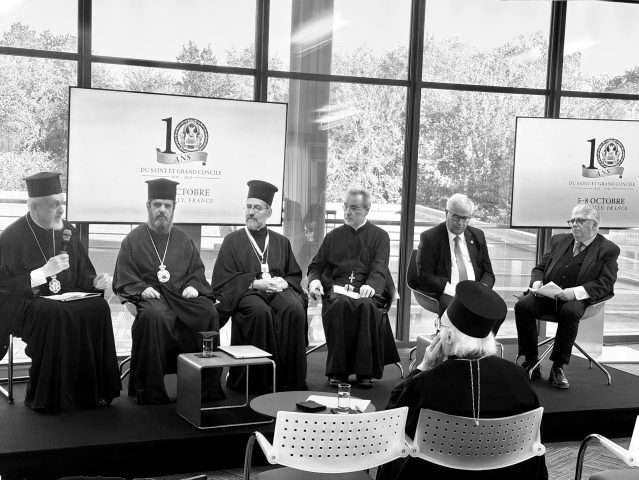







At last month’s AI and Theology working group meeting, Constantine Psimopoulos shared his presentation from the recent Post-Humanism and Artificial Intelligence International Scientific Conference (PHAICON), which he attended in the fall of 2024. He also reflected on conversations that unfolded at the conference, drawing our attention to points of concern among Orthodox Christians. Constantine Psimopoulos is an instructor in Bioethics and Human Flourishing in the Harvard Initiative on Health, Spirituality and Religion, and Professor (Adj.) of ethics, at Holy Cross Greek Orthodox School of Theology.
His presentation—Post-Humanism Ethos: From a meta-anthropo-‘logic’ to a meta-ethics “logos”—had two focuses: first, he drew attention to the life-giving aspects of applications of artificial intelligence in medical research, and second, he noted the ongoing debate over whether or not LLM’s and AI are, or are becoming, sentient.
In service of the first focus, he highlighted the medical advances made possible by recent advances in AI. He noted that since there were many at the conference who viewed AI from a standpoint of skepticism at the best, and terror at worst, much of his presentation was spent drawing attention to the lifegiving aspects of AI. Several medical breakthroughs have been made possible by the computing power of AI. Due to prohibitive research costs, potential treatment protocols for rare diseases often remain under-researched. A new AI program employed by the Broad Institute of MIT and Harvard has been applied to the task of identifying potential treatment protocols from the millions of existing combinations. This task, which involves parsing through billions of treatment protocols, can be performed by an algorithm in a manner consuming much less time and resources than would be required of human researchers.
Another example of AI advancing medical research is a novel mode of decoding the genome of brain cancer during surgery. Without the aid of AI, during surgery, a surgeon must make a judgement that balances the risks of removing too much or too little of a brain tumor. With a less aggressive tumor, removing more of the tumor than necessary may negatively affect the patient’s neurologic and cognitive function. Likewise, removing too little from a tumor that is highly aggressive may leave behind malignant tissue that can grow and spread quickly. Even for the most skilled surgeons, it is difficult to judge the correct balance to strike. AI can now be employed to analyze the genome of the tumor cells during surgery, so that the surgeon can then operate in accord with the aggressiveness of the cancer cells present.1
After drawing our attention to these goods, his presentation turned to the second focus: a discussion of the degree to which LLMs may or may not be able to employ logical and moral reasonings in a manner akin to humans. Chat GPT and similar programs are unlimited by design in what they can learn or otherwise memorize: the question becomes are they capable of distinguishing the possible from the impossible? The answer, for Psimopoulos, is simply no, which then raises many other ethical issues.
AI, though not created in the image and likeness of God, is created in the image and likeness of humans. Psimopoulos quoted from the Social Ethos document, which states that “the desire for scientific knowledge flows for the from the same wellspring as faith’s longing to enter ever more deeply into the mystery of God,” and noted that the creation of AI may be instances of human co-creation with God. However, he also cautioned that both the human position as co-creator, and the prototype for artificial intelligence mean that AI will mimic not only the good and beautiful aspects of humans, but also their biases and shortcomings. In short, AI is only as ethical as its algorithm’s parameters.
On the question of whether AI has access to logic and reasoning in the way that humans do, Psimopoulos drew on Smith (2019),2 who “makes the case that the artificial intelligence systems have failed to produce human-level intelligence and, he emphasizes, judgment. Human intelligence, he argues, is of a different order than even the most powerful calculative ability of artificial computational systems.”3 In agreement with Smith, Psimopoulos suggested that the ability of AI may more accurately be described as “reckoning,” rather than thinking and exercising reason. AI perform algorithmic functions, but cannot deliver human-quality judgment, which is “deliberative thought grounded in ethical commitment and responsible action.”4
“AI draws from every dimension of cosmic existence and adopts the data points and training in its algorithms that humans decide to use or embed in them, with all conscious or unconscious biases that they bring along with or in them.” This “equitable, free-of-bias, legitimate, and necessary scientific research” is described in the Social Ethos document as “the Christian’s mission to transfigure the world in the light of God’s Kingdom.” AI research and development carried out within this framework then are instances of humans reaching out, through their co-creation, “to all of creation, to all of life, to every dimension of cosmic existence” (Social Ethos Document, Paragraph 69).
A potential danger in the creation of AI’s that can perform in ways that approach human-level thinking is that the biases and shortcomings of their human creators may become embedded in the algorithms. In other words, AI is as good, or as ethical as its algorithm, which is as good and as ethical as its creator(s). Psimopoulos suggested that the bioethics principles of respect, beneficence, equity, and justice should be adhered to in AI research, and suggested that the four centuries on love and charity in Saint Maximus of Confessor, may serve as a guide for applying bioethical principles within an Orthodox framework.
Psimopoulos concluded his presentation with a quote from Paul Farmer, who said that “the idea that some lives matter less is the root of all that is wrong with the world.”5 LLMs and AI which can be created to help in the co-creation of a more just and equitable world. But first we must acknowledge and rid ourselves of our own biases before we can expect any of our future sentient creations to operate without such bias.
In the ensuing discussion, several insightful questions and points were raised. The first question was in response to a written reflection by PHAICON organizer Dr. Nikolaos Koios, in which he postulated that “Posthumanism and Transhumanism are phenomena that influence and will increasingly influence individual and societal life. Especially the woke culture with its trans agenda becomes a vehicle for the inversion of values and the distortion of concepts through the institutional promotion of all types of individual desires and base passions.”6 One of our working group attendees asked for clarification on how the conference organizers had defined both “transhumanism” and “posthumanism.” The organizers had presented posthumanism as something that we have yet to experience: those human beings who are going to be born completely out of genetically engineered embryos. In other words, posthumanism would include both the emergence of sentient beings that are not biological, and an evolved or modified version of humans that can be classified as a newly emergent, and non-human, species of being. Transhumanism refers to human beings that were born in an unmodified state, but who will be modified to some extent during their lifetimes.
The point was then made that this last category is quite broad and open to many interpretations. For instance, a person may have a pacemaker implanted, wear glasses or hearing aids, or require an insulin pump. Likewise, life-saving medications—such as those that control blood pressure, prevent blood clots, prevent or lessen seizure activity, slow the progression of Alzheimer’s and Parkinson’s, and stop the growth of cancers, to name just a few—might also fall under the very broad umbrella of the conference organizers understanding of “posthumanism.” These are necessary medical interventions that alter the natural state of the human bodies in question, yet most people would not consider these medical responses to sickness instances of transhumanism. These health interventions point to the gradual way in which transhumanist developments occur and suggest that transhumanism is not a thing of the future, but rather, of the present.
After clarifying the meaning that the organizers of PHAICON intended to communicate by their use of the terms “transhumanism” and “posthumanism,” the discussion then turned to the standard semantic range of the terms in academic literature. One attendee clarified that posthumanism is a movement which involves philosophers and other humanities scholars, including among its most notable subscribers Donna Haraway, known for her Cyborg Manifesto.7 Another prominent thinker, Michel Foucault, in his text the order of things, a book he wrote in the late sixties or early seventies, argued that the idea of humanism, and it’s a conception of humanity comes out of the renaissance. It’s a certain conception of humanity that, in many respects, privileges white males. But Foucault argued that humanism and its conception of humanity is being supplanted. Humanism was a particular intellectual movement that understood human beings to be at the center of the universe. Posthumanism then is, in some ways, a rethinking of what human beings are and what place they hold in the universe.
Biology, genetics, and environmental science, among other disciplines, all show that human beings are perhaps not best understood as being the center of everything, but rather as part of networks. An example of this, of course, is that all human beings have many, many cells within their bodies—microbiomes—with which they don’t share their DNA. We could not exist, let alone be healthy, without these microbiomes. Individual humans are systems within networks, not independent autonomous individuals that the Humanist and Renaissance philosophers understood human beings to be.
The term “transhumanism,” first coined by Julian Huxley, refers to the idea that human beings can take control of their evolution and (re)make themselves into whatever they desire.8 The transhumanist movement encompasses a wide variety of people with different religious and philosophical perspectives, but who all agree that there is the possibility of transforming our species, and that this is something that should be pursued.
Building on this clarification of the terms, the conversation then turned to the question of why some people—such as the author of the PHAICON review—might be fearful about transhumanist developments in technology and medicine. In essence, people are afraid of people and things that trouble their conceptions of “normal,” or “natural.” It was pointed out that, prior to passing the Americans with Disabilities Act (ADA), differently abled persons were not guaranteed fair treatment under the law and were frequently subjected to dehumanizing situations and behaviors. Similarly, prior to the civil rights act, Black Americans were subject to legally sanctioned discrimination—a legacy that continues to negatively impact the health and wellbeing of millions of Black Americans to this day. Until quite recently, non-straight sexual orientations were considered disordered, and those who were classified as LGBTQ were treated as less than human. The common factor in each of these three examples is that the dominant social group acted out of a very narrow understanding of what it meant to be human: straight, white, and able-bodied. Also in each case, well-informed advocates worked diligently to educate lawmakers, religious leaders, and communities, thus bringing about changes of heart and mind through the sharing of knowledge and through genuine encounters. Of course, no one in the working group was advocating for cyborgs being counted as human, but there was a shared concern over the reasoning espoused in the referenced review. The PHAICON organizers, in grouping posthumanism and transhumanism together with “woke culture with its trans agenda,” problematically recapitulate the very fear-based thinking which undergirds ableist, homophobic, and racist ideologies. Further, these fear-based ideologies are antithetical to Orthodox Theology in that they refuse to acknowledge the innate holiness of each human being, as created in the image and likeness of God.9
But what about the idea of transhumanism within the Orthodox tradition? It could be argued that Orthodox eschatology even espouses a form of transhumanism: consider the many speculations over what the resurrected body will look like; likewise, recall Jesus’ words that “at the resurrection people will neither marry nor be given in marriage; they will be like the angels in heaven” (Matthew 22:30).10
In considering the problematic conclusions of the PHAICON organizers—both in light of the broader definitions of transhumanism and posthumanism among the scholarly community, and in light of Orthodox eschatology—several points of best practice for ongoing conversations around posthumanism, transhumanism, and their respective relationships with AI can be established. First, engagement with the body of literature espousing both transhumanism and posthumanism is necessary to avoid making false equivalencies. Second, it will be helpful to examine underlying ideologies amongst conversation partners to identify biases that may distract from the topic of conversation. Third, an acquaintance with scriptural and patristic eschatological traditions will allow conversation partners to avoid inadvertently making statements that contradict their own Orthodox tradition.
1. Constantine Psimopoulos, “Post-Humanism Ethos: From a meta-anthropo- ‘logic’ to a meta-ethics ‘logos’ of AI,” a presentation delivered to the AI-Theology working group, February 21, 2025.
2. Smith, 2019.
3. Psimopoulos, “Post-Humanism Ethos.”
4. Giannakidou, The Human and the Mechanical: logos, truthfulness, and ChatGPT, 2024; cit. in Psimopoulos, “Post-Humanism Ethos.”
5. Paul Farmer, reported conversation.
6. Nikolaos Koios, “PHAICON24 CONFERENCE FINDINGS,” Dec. 2, 2024.
7. Donna Haraway, Cyborg Manifesto: Science, Technology, and Socialist-Feminism in the Late Twentieth Century, 1985.
8. Julian Huxley, “Knowledge, Morality and Destiny,” Psychiatry 14 (1951): (129–51), 139.
9. A position that was recently underscored in the Social Ethos Document, For the Life of the World.
10. Ἐν γὰρ τῇ ἀναστάσει οὔτε γαμοῦσιν, οὔτε ἐκγαμίζονται, ἀλλ’ ὡς ἄγγελοι τοῦ θεοῦ ἐν οὐρανῷ εἰσιν.
Recent Articles
-
Archbishop Elpidophoros Latest News The Archdiocese
 Hellenic Olympic Committee President Isidoros Kouvelos, left, and former Greek Foreign Minister Dora Bakoyannis, right, meet with His Eminence Archbishop Elpidophoros of America at the Greek Orthodox Archdiocese of America headquarters in New York on Oct. 14, 2026. Photo by Orthodox Observer/Yannis Malevitis5 min read